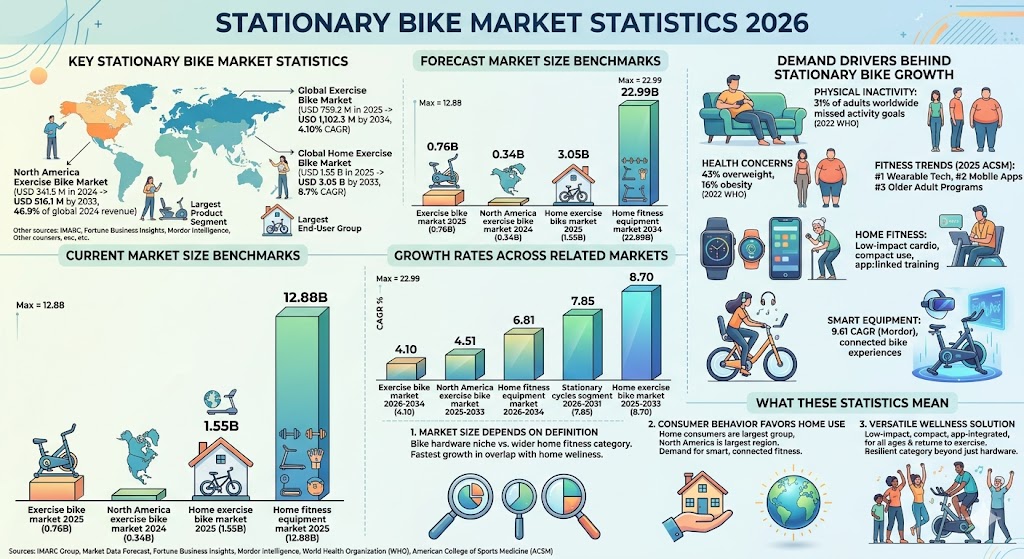
The stationary bike market is usually reported under exercise bikes, home exercise bikes, or stationary cycles. Across those lenses, the category ranges from a sub-billion-dollar hardware niche to a much larger growth pocket inside home fitness equipment.
stationary bike market statistics
The latest market data shows steady expansion in core exercise bikes, faster growth in home-use bikes, and strong momentum for stationary cycles inside the wider home fitness category.
Key Stationary Bike Market Statistics
IMARC Group values the global exercise bike market at USD 759.2 million in 2025 and forecasts it to reach USD 1,102.3 million by 2034.
That implies a 4.10 CAGR for the global exercise bike market from 2026 to 2034.
IMARC’s earlier reporting cycle put the global exercise bike market at USD 728.0 million in 2024 and USD 1.06 billion by 2033.
The North America exercise bike market reached USD 341.5 million in 2024 and is forecast to hit USD 516.1 million by 2033.
Using IMARC’s 2024 global and North America figures, North America represented roughly 46.9% of global exercise bike revenue.
Market Data Forecast estimates the global home exercise bike market at USD 1.55 billion in 2025, rising to USD 3.05 billion by 2033.
That home exercise bike forecast implies a much faster 8.7 CAGR than the broader global exercise bike category.
Fortune Business Insights values the home fitness equipment market at USD 12.88 billion in 2025 and projects USD 22.99 billion by 2034.
Fortune Business Insights says North America held 37.46% of the home fitness equipment market in 2025.
Mordor Intelligence estimates the home fitness equipment market at USD 11.01 billion in 2025 and USD 17.06 billion by 2031.
Mordor says stationary cycles are the fastest-growing product type in home fitness equipment, with a 7.85 CAGR through 2031.
IMARC identifies recumbent bikes as the largest product segment and home consumers as the largest end-user group in the exercise bike market.
Current Market Size Benchmarks
These figures show how small the pure exercise-bike category is compared with the broader home fitness equipment market. That distinction matters because many headline numbers online mix bike-only totals with wider equipment categories.
Label
Bar
Value
Exercise bike market 2025
0.76B
North America exercise bike market 2024
0.34B
Home exercise bike market 2025
1.55B
Home fitness equipment market 2025
12.88B
Max = 12.88. Widths: Exercise bike market 2025 5.89%, North America exercise bike market 2024 2.65%, Home exercise bike market 2025 12.03%, Home fitness equipment market 2025 100.00%.
Forecast Market Size Benchmarks
Forward-looking estimates still point to growth for the category, but they also show that the biggest dollar pools sit in the broader home fitness ecosystem rather than in bike hardware alone.
Label
Bar
Value
Exercise bike market 2034
1.10B
North America exercise bike market 2033
0.52B
Home exercise bike market 2033
3.05B
Home fitness equipment market 2034
22.99B
Max = 22.99. Widths: Exercise bike market 2034 4.79%, North America exercise bike market 2033 2.24%, Home exercise bike market 2033 13.27%, Home fitness equipment market 2034 100.00%.
Growth Rates Across Related Markets
The pure exercise-bike market is growing, but the faster story sits in home-use bikes and stationary cycles within the wider home fitness sector. Values below are CAGR percentages.
Label
Bar
Value
Exercise bike market 2026-2034
4.10
North America exercise bike market 2025-2033
4.51
Home fitness equipment market 2026-2034
6.81
Stationary cycles segment 2026-2031
7.85
Home exercise bike market 2025-2033
8.70
Max = 8.70. Widths: Exercise bike market 2026-2034 47.13%, North America exercise bike market 2025-2033 51.84%, Home fitness equipment market 2026-2034 78.28%, Stationary cycles segment 2026-2031 90.23%, Home exercise bike market 2025-2033 100.00%.
Regional and Segment Takeaways
Recumbent bikes lead the product mix in IMARC’s global exercise bike market breakdown.
Home consumers are the largest buyer group, which keeps the category tied closely to home wellness and hybrid fitness behavior.
North America is the largest region in IMARC’s global exercise bike market view.
The North America exercise bike market is projected to rise from USD 341.5 million in 2024 to USD 516.1 million by 2033, a gain of about 51.1%.
The global home exercise bike market is projected to rise from USD 1.55 billion in 2025 to USD 3.05 billion by 2033, a gain of about 96.8%.
The global home fitness equipment market is projected to rise from USD 12.88 billion in 2025 to USD 22.99 billion by 2034, a gain of about 78.5%.
Demand Drivers Behind Stationary Bike Growth
WHO says 31% of adults worldwide did not meet recommended physical activity levels in 2022.
WHO also says 43% of adults were overweight and 16% were living with obesity in 2022.
ACSM’s 2025 fitness trends ranked wearable technology #1, mobile exercise apps #2, and exercise programs for older adults #3.
Those trend signals align well with stationary bike demand because bikes fit app-linked training, low-impact cardio, and at-home exercise routines.
IMARC highlights health awareness, home fitness demand, and technology upgrades such as VR, AI, and machine-learning-based personalization as growth drivers for exercise bikes.
Mordor says smart equipment is the fastest-growing category in home fitness equipment, with a 9.61 CAGR, reinforcing the shift toward connected bike experiences.
What These Statistics Mean
The first big takeaway is that the stationary bike market is healthy, but its size depends heavily on how the category is defined. A strict exercise-bike view remains below USD 1.2 billion globally even by 2034, while a home exercise bike lens is already measured in the low billions and growing faster.
The second takeaway is that consumer behavior still favors home use. Home consumers are the largest end-user group, North America remains the largest region, and the fastest growth rates show up where bikes overlap with smart, connected, home-based fitness.
The third takeaway is that stationary bikes are becoming more attractive because they solve several demand problems at once: low-impact cardio, compact home use, app integration, and suitability for older adults or people returning to exercise. That makes the category more resilient than a simple hardware-only market size might suggest.
Sources
IMARC Group, Exercise Bike Market Report by Product Type, End-User, and Region, 2026-2034: global exercise bike market at USD 759.2 million in 2025, forecast USD 1,102.3 million by 2034, CAGR 4.10, recumbent largest product segment, home consumers largest end user, North America largest region, and key players including Brunswick, Icon Health & Fitness, Nautilus, Precor, and Technogym.
IMARC Group, North America Exercise Bike Market: North America market at USD 341.5 million in 2024 and forecast USD 516.1 million by 2033, CAGR 4.51.
IMARC Group, Global Exercise Bike Market: global market at USD 728.0 million in 2024 and forecast USD 1.06 billion by 2033, CAGR 4.3.
Market Data Forecast, Home Exercise Bike Market: global home exercise bike market at USD 1.55 billion in 2025 and forecast USD 3.05 billion by 2033, CAGR 8.7.
Fortune Business Insights, Home Fitness Equipment Market: home fitness equipment market at USD 12.88 billion in 2025 and forecast USD 22.99 billion by 2034, with North America holding 37.46% share in 2025.
Mordor Intelligence, Home Fitness Equipment Market: market at USD 11.01 billion in 2025 and forecast USD 17.06 billion by 2031, with stationary cycles the fastest-growing product type at 7.85 CAGR and smart equipment the fastest-growing category at 9.61 CAGR.
World Health Organization, Physical Activity: 31% of adults worldwide did not meet recommended physical activity levels in 2022.
World Health Organization, Obesity and Overweight: 43% of adults were overweight and 16% were living with obesity in 2022.
American College of Sports Medicine, Top Fitness Trends for 2025: wearable technology ranked #1, mobile exercise apps #2, and exercise programs for older adults #3.