Spinning bikes sit at the intersection of home fitness, connected training, and high-intensity cardio. The latest data shows that spin-style workouts benefit from strong demand for connected equipment, clear calorie-burning potential, and growing evidence that indoor cycling can improve aerobic fitness, body composition, and several cardiometabolic markers.
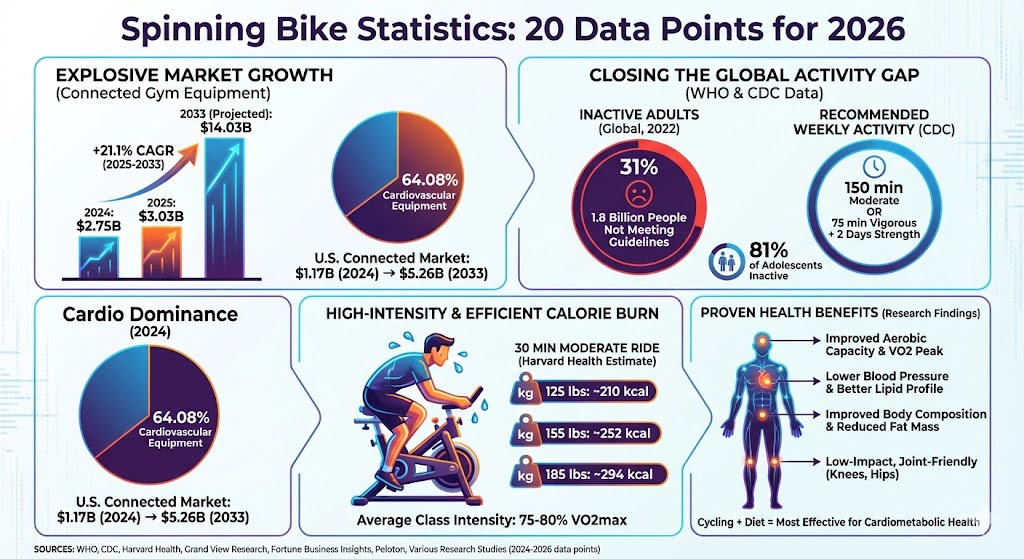
Key spinning bike statistics
- The global connected gym equipment market was valued at $2.75 billion in 2024 and is projected to reach $14.03 billion by 2033.
- The same connected gym equipment market is forecast to expand at a 21.1% CAGR from 2025 to 2033.
- Cardiovascular training equipment held 64.08% of the connected gym equipment market in 2024, which is the category that includes stationary bikes and other cardio machines.
- The U.S. connected fitness equipment market was estimated at $1.17 billion in 2024 and is expected to reach $5.26 billion by 2033.
- The broader global home fitness equipment market was valued at $12.88 billion in 2025 and is projected to hit $22.99 billion by 2034.
- Peloton reported 2.661 million paid connected fitness subscriptions in fiscal Q2 2026.
- WHO says 31% of adults worldwide, or about 1.8 billion people, did not meet recommended activity levels in 2022.
- WHO also reports that 81% of adolescents globally were physically inactive.
- CDC guidance says adults should get 150 minutes of moderate activity or 75 minutes of vigorous activity each week, plus 2 days of muscle-strengthening activity.
- Harvard Health estimates that 30 minutes of moderate stationary biking burns about 210 calories at 125 pounds, 252 calories at 155 pounds, and 294 calories at 185 pounds.
Spinning bike market statistics
From a business standpoint, spinning bikes are riding two trends at once: cardio equipment demand and connected fitness adoption. That helps explain why exercise bikes continue to matter in both home-gym and studio-style ecosystems.
- The global connected gym equipment market was worth $2,754.7 million in 2024.
- That market is expected to reach $3,026.3 million in 2025.
- By 2033, the connected gym equipment market is projected to reach $14,027.3 million.
- North America held 51.03% of the connected gym equipment market in 2024.
- The business-to-consumer segment accounted for 76.74% of connected gym equipment revenue in 2024.
- The U.S. connected fitness equipment market is expected to grow from $1.28 billion in 2025 to $5.26 billion in 2033.
- In the broader home fitness category, North America held a 37.46% market share in 2025.
- Cardiovascular equipment represented 58.89% of the home fitness equipment market in 2024.
| Label | Bar | Value | ||
|---|---|---|---|---|
| 2024 global connected gym equipment market |
| $2,754.7M | ||
| 2025 global connected gym equipment market |
| $3,026.3M | ||
| 2033 global connected gym equipment market |
| $14,027.3M |
Max = 14,027.3. Widths: 2024 global connected gym equipment market 19.64%, 2025 global connected gym equipment market 21.57%, 2033 global connected gym equipment market 100.00%.
Spinning bike participation and activity statistics
Spin bikes matter partly because they offer a practical way to close the physical-activity gap. The gap is still large enough that any scalable indoor cardio format has room to grow.
- WHO estimates that 31% of adults worldwide were physically inactive in 2022.
- That equals roughly 1.8 billion adults not meeting the minimum recommendation.
- Adult inactivity increased by 5 percentage points between 2010 and 2022.
- If the trend continues, WHO projects adult inactivity could reach 35% by 2030.
- Globally, women are less active than men by an average of 5 percentage points.
- After age 60, physical inactivity rises in both men and women.
- WHO reports that 81% of adolescents aged 11 to 17 were physically inactive.
- Among adolescents, 85% of girls and 78% of boys did not meet guidelines.
- CDC says adults can meet weekly aerobic guidance with 30 minutes a day, 5 days a week.
- CDC also notes that going beyond 150 minutes of moderate activity or 75 minutes of vigorous activity can deliver even greater health benefits.
Spinning bike workout and calorie statistics
One reason spin bikes remain popular is that they can be both efficient and intense. Research consistently places indoor cycling in a fairly demanding cardio zone, especially in coached or interval-based sessions.
- A frequently cited indoor cycling study found that the average 45-minute class ran at 75% to 80% of VO2max.
- The same research summary reported that 52% of class time was spent above the ventilatory threshold.
- A separate real-world indoor cycling study found an average main-phase intensity of 80.62% heart-rate reserve, which falls into a high-intensity range.
- In that same real-world study, the average Borg rating of perceived exertion was 14.94.
- The average OMNI perceived-exertion score in the same study was 7.18.
- Researchers also found that more than 50% of participants were actually working harder than they believed they were.
- A controlled 2020 study found very strong agreement between oxygen uptake and class intensity guided by RPE (r = 0.986) and heart rate (r = 0.977) in experienced riders.
- Harvard Health estimates that 30 minutes of moderate stationary biking burns 210 calories for a 125-pound person.
- The same 30-minute ride burns about 252 calories for a 155-pound person.
- For a 185-pound person, that 30-minute moderate ride is estimated at 294 calories.
| Label | Bar | Value | ||
|---|---|---|---|---|
| 125 lb rider |
| 210 calories | ||
| 155 lb rider |
| 252 calories | ||
| 185 lb rider |
| 294 calories |
Max = 294. Widths: 125 lb rider 71.43%, 155 lb rider 85.71%, 185 lb rider 100.00%.
Spinning bike health statistics
Evidence on spin-style workouts is stronger than many casual buyers assume. While not every study is large, the direction of findings is fairly consistent: indoor cycling is a low-impact format that can still produce meaningful cardiovascular and body-composition effects.
- A systematic review of indoor cycling studies screened 300 studies and included 13 studies with a total sample of 372 participants.
- That review reported that indoor cycling may improve aerobic capacity, blood pressure, lipid profile, and body composition.
- The review concluded that indoor cycling plus diet is the most effective combination for improving lipids, reducing blood pressure, and supporting weight loss.
- The same review concluded that indoor cycling alone may still improve aerobic capacity.
- In women with obesity, a 12-week indoor cycling program was associated with decreases in body mass, total cholesterol, OLAb, TBARS, and C-reactive protein.
- That same 12-week program was also associated with increases in skeletal muscle mass and HDL cholesterol in women with obesity.
- VO2 peak in the women-with-obesity group improved from 16.93 to 20.59 mL/kg/min after the intervention.
- The Arthritis Foundation describes cycling as a low-impact workout that strengthens muscles supporting the knees, ankles, and feet.
- It also notes that research has shown cycling can improve outcomes for hip osteoarthritis.
- A hip osteoarthritis research paper describes cycling as a non-weight-bearing, low-impact exercise that can help increase range of movement, strength, and function while reducing pain.
What these spinning bike statistics mean
The numbers point in the same direction. Spinning bikes benefit from strong connected-fitness demand, fit neatly into public-health guidance on weekly activity, and offer a relatively joint-friendly way to perform hard cardio indoors. For brands, that means continued relevance in both premium connected ecosystems and traditional cardio categories. For consumers, it means spin bikes remain one of the clearest ways to combine convenience, calorie burn, and structured training at home or in a class setting.
Sources
- World Health Organization, Physical Activity Fact Sheet, 2024.
- CDC, Adult Activity: An Overview, updated guidance page.
- Harvard Health, Calories Burned in 30 Minutes for People of Three Different Weights.
- Grand View Research, Connected Gym Equipment Market Report, 2025 update.
- Grand View Research, U.S. Connected Fitness Equipment Market Report.
- Fortune Business Insights, Home Fitness Equipment Market Report.
- Peloton investor reporting, fiscal Q2 2026 subscription disclosure.
- Muyor et al., Exercise Intensity and Validity of the Ratings of Perceived Exertion in an Indoor Cycling Session.
- Canário-Lemos et al., Are Heart Rate and Rating of Perceived Exertion Effective to Control Indoor Cycling Intensity?
- Chavarrias et al., Health Benefits of Indoor Cycling: A Systematic Review.
- Ratajczak et al., Effects of an Indoor Cycling Program on Cardiometabolic Factors in Women with Obesity vs. Normal Body Weight.
- Arthritis Foundation, Biking Is Great for Your Joints.
- Wainwright et al., Cycling intervention design work for hip osteoarthritis.